Sun Valley & the Wood River Valley
Artwork Placement & In-Home Consultation
We help you decide where your artwork belongs, then turn those decisions into a plan that can actually be installed.
Sometimes that takes an afternoon and three opinions. Sometimes it takes measurements, layouts and a second visit. Either way, you end up knowing where things go and why.
The Right Wall Is Not Always the Empty One
The biggest bare wall in the house tends to get nominated first. It's the obvious candidate, and fairly often it's the wrong one. A painting can fit that wall with room to spare and still look stranded, because scale isn't only about dimensions. It's about proportion, what sits underneath, how much space surrounds the piece and how far away you stand when you look at it.
So we pay attention to how the room is used. Where you walk. What you see first when you come through the door. Whether the piece is met head on from ten feet away or glanced at in passing. Viewing height matters, and so does what's competing for attention nearby: a window, a television, a strong light source, or another artwork that would rather not share the view.
None of this is a rulebook. Plenty of good placements break the conventional guidance for a reason that's obvious once you're standing in the room. What we're really doing is telling the difference between artwork that technically fits and artwork that looks like it belongs there.
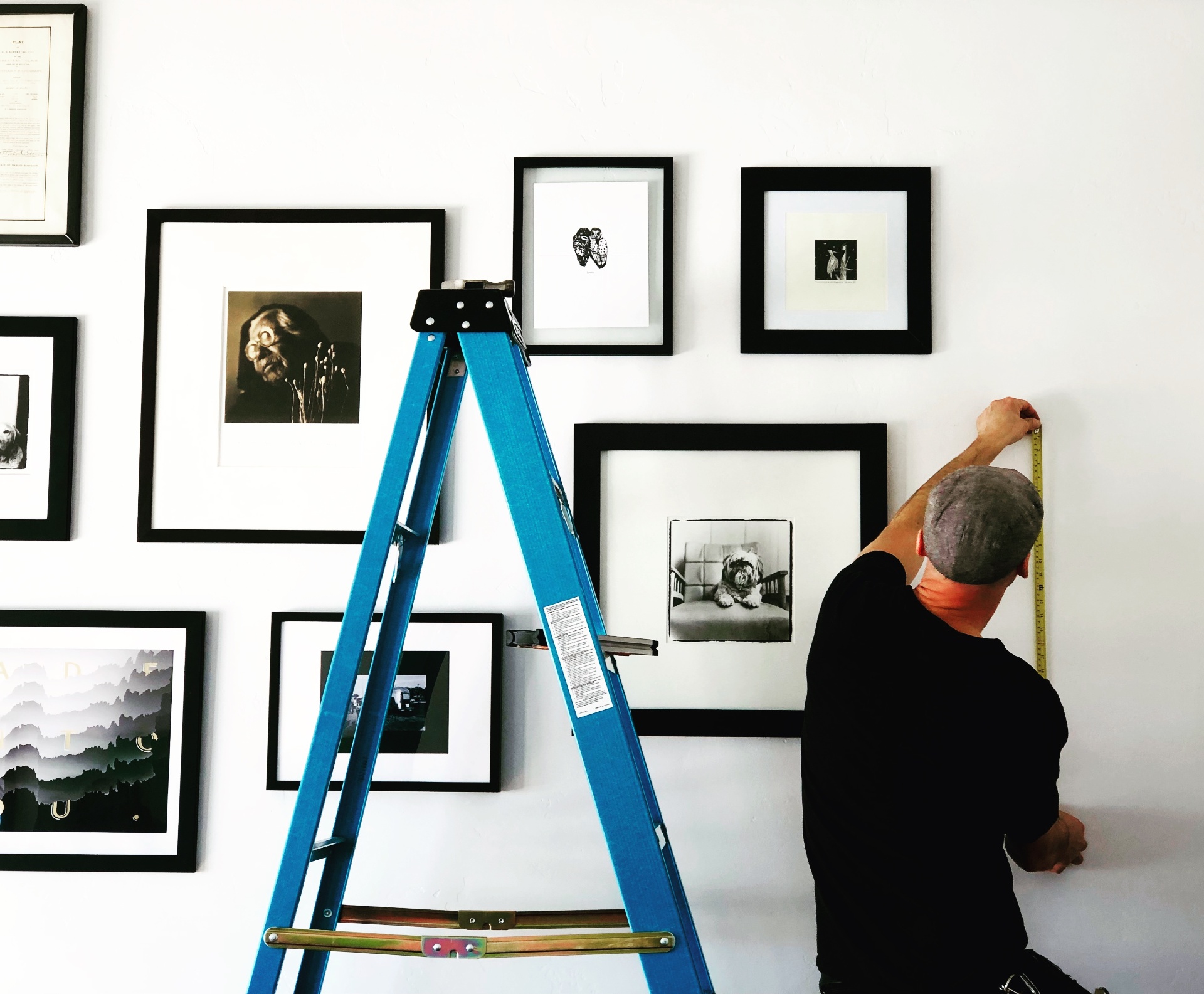
Working With the Art You Already Own
This service is about the artwork in your possession, not artwork you're being encouraged to acquire. We don't buy, sell or source work, and we don't appraise or authenticate it. We help you live with what you have. Common situations:
- A collection built up over many years
- Artwork inherited or brought from another home
- Pieces coming back out of storage
- Recent purchases already chosen elsewhere
- A collection being spread through a new house
- Work displaced by remodeling or new furniture
- Pieces that have never gone up because the right spot never presented itself
- Seasonal or occasional rotations
Collections accumulate for personal reasons and rarely follow one decorative logic. A print bought on a honeymoon and a serious contemporary painting can hang in the same house without apology. Our job is to find each piece a place that suits it, not to make the collection look like it came from a single catalog.
Room by Room, and Between Rooms
Walls are easier to solve when you stop treating them as separate problems. We look at the whole property and think about what you see from where. Entryways set the tone for everything after them. Hallways are viewed at close range and at speed. Staircases and high walls have their own geometry, and dining rooms are seen mostly while seated, which changes the height question entirely.
- Entries and landings
- Living and dining areas
- Bedrooms and guest rooms
- Hallways and circulation space
- Staircases and tall walls
- Offices and studies
- Pedestals, niches and locations suited to sculpture
- Covered outdoor and transitional spaces, where the medium allows it
Some of the best placements come from thinking about the view between rooms. A strong piece at the end of a hallway gives you something to walk toward. That can be worth more than putting the same work on a larger wall where it's only ever seen straight on. Not every location suits every medium, though. Works on paper, photographs and anything sensitive to sun or moisture need more care about where they end up, and we'll say so rather than let a nice sightline win the argument.
Scale, Sightlines and Visual Weight
Two paintings of identical size can behave completely differently on the same wall. A dark, densely painted canvas holds a room. A pale watercolor in a slim frame lets the wall show through and needs company or a smaller space to feel settled. Framing changes the arithmetic too: a wide mat and a substantial frame can add a foot in every direction and turn a modest work into the main event.
Format matters as much as area. A tall vertical piece will do things to a low-ceilinged room that a horizontal work of the same square footage won't. Over a sofa or console, the width of the furniture usually sets the sensible range for the artwork above it, and the empty space around a piece is doing real work, not going to waste.
Viewing distance decides a lot of it. A detailed work rewards standing close and loses something on a wall you only see from across the room. When several works are near each other, they start borrowing weight from one another. Sometimes a single piece needs the wall to itself. Sometimes three or four smaller works read better together than any of them would alone, and at that point we're into gallery wall territory.
Planning Tools When They Help
For a straightforward decision, the fastest tool is two people holding a painting against a wall while a third stands back and says yes or no. We do that a lot, and it's often enough. When a project is larger or the pieces aren't on site yet, we work from wall measurements, artwork dimensions, room photographs and reference points for furniture, windows and trim.
From that we can build scaled layouts or mockups to compare candidate locations. It's useful when you're weighing the same painting in three different rooms, or deciding which of two works should take the wall you see from the entry. Comparing options on screen is cheap; changing your mind after the hardware is in is less so.
These are planning tools, not photographs of the finished room. Screen color, lighting, frame depth and the plain physical presence of an artwork never translate exactly. We treat a layout as a well-informed prediction and expect to adjust a little once the piece is actually in front of us.
Placement With Installation in Mind
This is where a placement conversation with an installer differs from one without. A location can look perfect and still create a problem: a heavy work over a stone fireplace, a large canvas above a staircase with nowhere to stand a ladder, a delivery path with a turn the crate won't make. Better to know that while the plan is still a plan.
So while we're looking at sightlines we're also quietly noting wall construction, artwork weight, what hardware the piece and the surface will need, access to the location, fragile or irregular frames, multi-part works that have to align, and the mounting points or base a sculpture requires. If a spot is going to need equipment or an extra pair of hands on install day, we'd rather raise it now than discover it with the artwork unwrapped in the hallway.
We're not engineers, and we don't pretend to be. Where a location calls for structural review, fabricated hardware, concrete work, lifting equipment or a licensed trade, we identify what's needed and coordinate it while handling the artwork side ourselves. Most placements are simpler than that: see picture hanging for framed work, and sculpture installation for dimensional pieces.
Working Alongside Designers and Other Professionals
Plenty of our placement work happens on projects that already have a designer, an architect, a builder or a property manager involved. That's a good thing. We stay in our lane and stick to the artwork. Depending on the project, we can:
- Develop placement recommendations directly with a collector
- Work from an interior designer's existing plan
- Act as a second set of eyes on decisions already made
- Flag practical installation concerns early
- Measure and document agreed locations
- Carry out the final installation
- Coordinate with builders, architects, property managers and household staff
If we think a proposed location will cause trouble, we'll say so early and explain why. From there, we work with you and the other professionals involved to find a safe, practical way forward.
How It Works
Review the Collection
We go through what you own or what's arriving: sizes, framing, weight, any visible handling concerns and which pieces matter most to you. Photographs and a list get us a long way before anyone visits.
Walk Through the Space
We look at the rooms the way you move through them, noting sightlines, light, furniture and architecture, and rule out the locations that won't hold up.
Develop the Placement Plan
Measurements, notes and, where they help, scaled layouts. You get clear recommendations for each piece, along with the alternatives we considered and why.
Install or Coordinate the Next Steps
We hang and install the work, or hand over a plan you can act on later. Where another trade or specialist is needed, we identify it and coordinate the artwork side.
The process should match the project. Three pieces and one room is usually settled in a single visit. Distributing a collection through a whole house takes measurements, layouts and a follow-up conversation or two.
What to Send Us
If you're getting in touch about placement, this is what helps most:
- Photographs of the artwork
- Artwork dimensions, including frames
- Approximate weights when you know them
- Photographs of the rooms and possible locations
- Approximate wall dimensions
- Furniture dimensions where they matter
- Floor plans or designer drawings if you have them
- Anything we should know about stairs, high walls or difficult access
- Whether the artwork is already on site
- Preferred timing
- Whether you'd like installation included
- Any pieces or locations that are especially important to you
None of it needs to be perfect. Clear phone photographs and reasonably accurate measurements are enough to start a useful conversation, and we can fill in the rest when we see the rooms.
Serving the Wood River Valley
We provide artwork placement consultations throughout the Wood River Valley. Projects beyond the valley are considered individually, depending on the scope, the location and how the scheduling works out.
Placement Questions
Can you help place artwork throughout an entire home?
Yes, and it's often the most useful way to do it. Looking at every room at once lets us see how the artwork works as a whole rather than solving one wall at a time. A piece that seemed obvious for the living room sometimes belongs at the top of the stairs, where you see it on the way past. We walk the house, look at what you own, and work out a plan room by room, with the pieces that matter most to you settled first.
Do we need to know where everything should go before you arrive?
Not at all. Most people call us precisely because they don't. Some clients have firm ideas about two or three pieces and no idea about the rest, and that's a perfectly good place to start. If you do already have a plan, we'll review it, tell you honestly what we think and flag anything that will be difficult to install.
Can you create digital previews of different placement options?
We can, when it genuinely helps. Using room photographs, wall measurements and artwork dimensions, we build scaled layouts so you can compare options before anything is hung. Treat them as accurate planning tools rather than photographs of the finished room. Lighting, color, frame depth and the physical presence of real artwork read differently in person, so we expect small adjustments once the work is actually in the room.
Can you work with our interior designer or architect?
Regularly. We can develop placement with you directly, work from a designer's existing plan, or act as a second set of eyes on decisions that have already been made. We're not there to take over anyone else's part of the project. Our job is the artwork: how it reads in the space and what will be required to install it properly.
Can the consultation include installation?
Yes. For most clients the consultation and the installation are one project. We look at the artwork and the rooms, agree on placement, then hang or install the work ourselves. You're welcome to use the consultation on its own if you'd rather handle the rest another way. What we don't do as part of this service is buy, sell or source artwork, or provide appraisals, valuations or authentication.
Related Services
Placement decisions usually lead somewhere. When several works end up together on one wall, that becomes gallery wall design. Once the plan is agreed, the hanging itself falls under picture hanging, or sculpture installation for freestanding and dimensional work.
If pieces are arriving from another house, a gallery or storage, we can handle transportation as part of the same project. For collections large enough that keeping track of them is its own job, see collection management, or look through all art services.